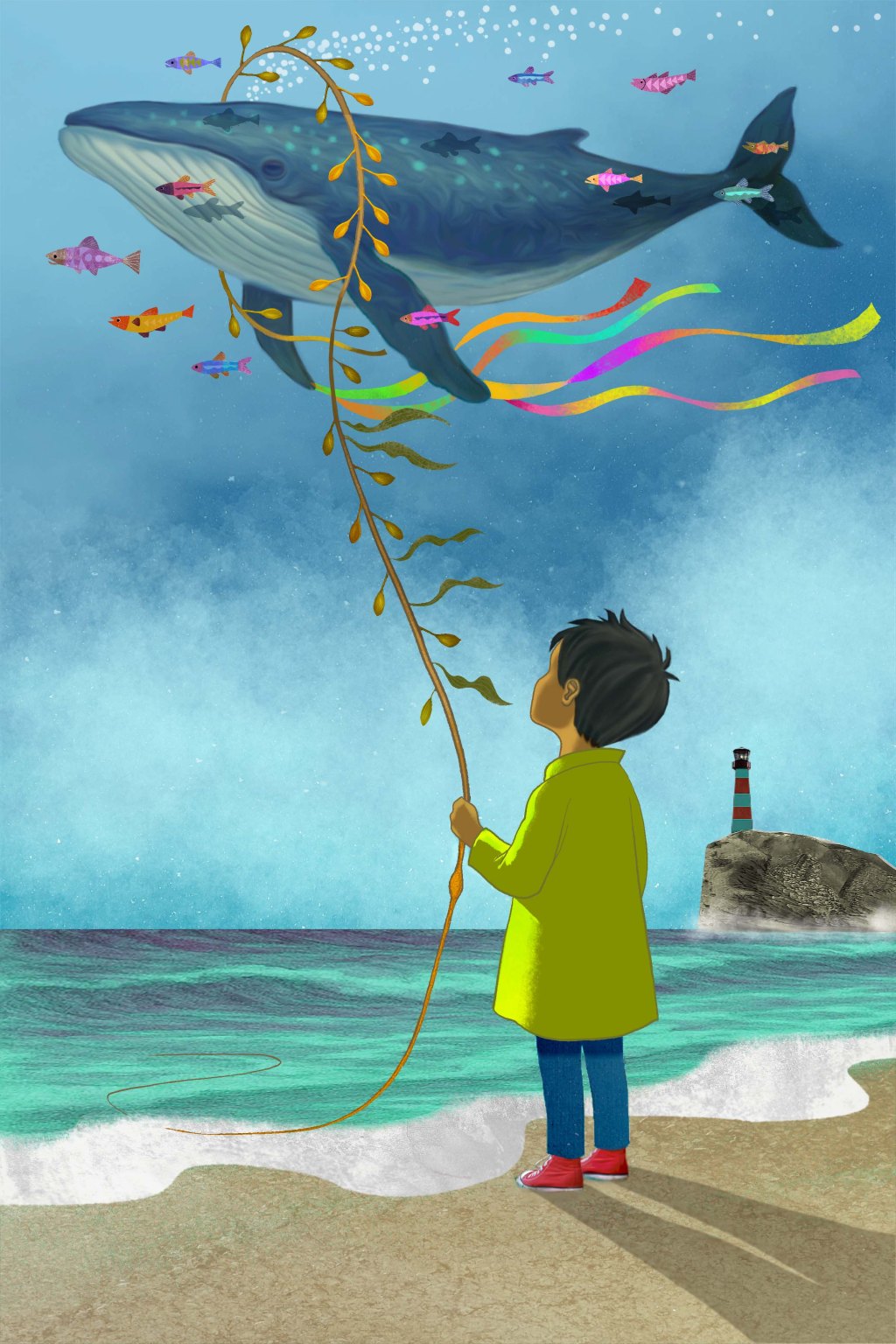
In my latest illustration, a child stands at the edge of the sea on a beach, holding a kite string made from kelp that stretches high into the clouds. Above drifts a playful whale, vast and gentle diving through the kelp, floating on the wind and waves.
Did you ever wonder how whales became the largest creatures ever to exist on Earth? Millions of years ago, whales evolved from small, prehistoric land animals that roamed the earth and walked on four legs. Over time, they returned to the sea and became natural swimmers. Gravity loosened its grip when they entered the water and food was abundant. What we now call a blowhole started as a pair of nostrils at the tip of their snout, then slowly moved to the top of their heads to help them breathe while swimming underwater.
Whale bones are flexible and highly adaptable to the ocean environment, much like many other creatures that swim underwater like the octopus. Their lungs can drop safely under deep-sea pressure, allowing them to breathe underwater for long extended time periods. The ocean has become their cradle of expansion.
Despite their massive size, blue whales feed almost exclusively on krill which are shrimp-like and the size of paperclips. Scientists believe whales grew larger as ocean temperatures cooled down and food sources like krill became concentrated. Their immense size allowed them to travel vast distances and store energy for long migrations.
Blue whales, the largest ocean giants of our planet, can weigh over 180 tons and their hearts alone are the size of a small car. The blue whale’s heart weighs about 400 pounds and can be heard beating from two miles away underwater. These creatures are even bigger than any known dinosaur that existed before them. Did you know a blue whale’s tongue alone can also weigh as much as an elephant? They communicate using dialects, songs, and even names unique to their pods.
Humpback whales compose songs that can last for hours on end and evolve over time. Scientists describe this as a form of cultural learning. Sperm whales have the largest brains on Earth, up to six times heavier than a human brain. They show signs of emotion, cooperation, and even grief. Whales also work as engineers to the Earth’s natural ecosystem. When they dive and resurface, they circulate nutrients in the ocean, helping microscopic organisms grow, which in turn produces much of Earth’s oxygen.
In my illustration, the whale kite becomes a symbol of imagination and evolution, a bridge between the child’s wonder and the whale’s ancient journey. It floats between worlds, reminding us that growth often comes from adaptation, curiosity, and the courage to change course.
Whales didn’t become the giants of the ocean by staying the same. They evolved, reshaping themselves into the creatures we know of today, following curiosity into new depths. As humans, we grow and evolve the same way. It happens when we find courage to explore what’s beyond the vast horizon waiting to be discovered in the bright future ahead. In my own life, I am learning to adapt when the tides shift, and trust that change in the future can lead us to extraordinary unexpected places.
 Santiago López Studio